Almost every crop, fruit and flower puzzle board runs the same three-step loop after you touch it. Learning to see the loop is the difference between hoping for a big chain and setting one up on purpose.
The loop has three steps, always in the same order
When you swap two tiles and something matches, the board does three things in sequence. It removes the matched tiles, it drops everything above them into the gap, and it fills the top row with new tiles. Then it checks the whole board again. If that check finds a new match, all three steps repeat.
That last sentence is the whole trick. The board does not check once, it checks in a loop until a pass produces nothing. Everything people describe as a cascade, a tumble or a chain reaction is simply the loop running more than once.
- Clear. The matched group disappears and is credited to whatever the level is counting.
- Drop. Tiles above the gap fall straight down. In almost all of these games they fall vertically only, which is why a hole in a column is far more useful than a hole spread across a row.
- Refill. New tiles enter from the top of the column, then the board re-checks.
The practical consequence: your move controls step one, gravity controls step two, and step three is out of your hands. Planning means arranging step two so that step three has somewhere useful to land.
Why the column matters more than the row
Because tiles fall vertically, a match that clears three tiles in a single column pulls the entire column down by three. A match that clears three tiles across a row pulls three separate columns down by one each. The first creates a deep gap that new tiles pour into; the second barely disturbs the board.
If a level is going badly, look at where your matches have been. A run of horizontal matches near the top of the board changes almost nothing underneath, and underneath is usually where the goal tiles are.

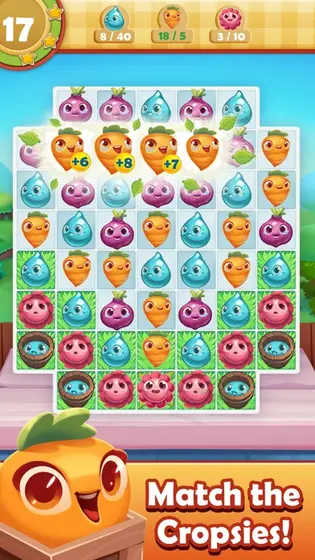

Reading a board before you touch it
Two or three seconds of looking is worth more than any booster. There are three things to check, and they take about as long to check as it takes to read this list.
- Where are the goal tiles? If they sit low on the board, a high match will not reach them. If they sit high, clearing beneath them brings them down.
- Which column is most crowded with one colour? That column is where a cascade is most likely to continue on its own.
- What is directly above your intended match? Those are the tiles that will land in the gap. If the three tiles above are the same colour as each other, the loop will very likely run a second time.
Setting up a chain instead of hoping for one
A deliberate chain is built from the bottom. Clear low, and everything above shifts into new positions; some of those positions will match by accident, and each accidental match repeats the loop. Clear high, and only the top few rows move, so the loop stops after one pass.
This is why experienced players often ignore an obvious four-tile match near the top in favour of a plain three-tile match at the bottom. The three-tile match is worth more because of what happens after it, not because of what it clears.
When the board is nearly empty
Late in a level, with few tiles left, cascades become unreliable in both directions. There is less material above to fall, so chains fizzle, but the refill is also less predictable because a larger share of the board is brand new tiles. If a level comes down to the last two moves, plan them as two separate single moves rather than counting on a chain to finish the job.
The part that really is random
The tiles entering from the top are drawn by the game, not chosen by you, and no sequence of moves changes what will arrive. Anything claiming otherwise, a pattern to force a colour, a tap rhythm, a lucky order, is wrong.
What you do control is the shape of the gap those tiles fall into. A tall narrow gap concentrates the new tiles in one column, which raises the odds of a vertical match among them. A wide flat gap spreads them out and lowers it. That is the entire extent of the influence available, and it is genuinely useful, which is why it is worth using rather than chasing superstitions.
A short exercise
Next time you open a level, do this once. Pick the lowest legal match on the board, even if a better-looking one exists higher up, and play it. Watch how far the board moves. Then restart the level and play the highest legal match instead, and watch again. The difference is usually larger than people expect, and after seeing it once it is difficult to stop noticing.