A collect goal asks for a number of specific tiles. That sounds like a small variation on clearing the board, and it is not: it inverts what counts as a good move.
What the counter is actually counting
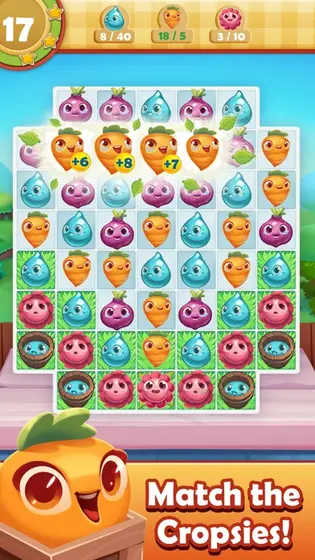
At the top of a collect level sits a small panel: an icon and a number. The number falls as you gather that tile. Nothing else on the board moves it. Clearing forty tiles of the wrong colour, in a chain that looks magnificent, moves the counter by zero.
This is the whole difficulty of the level type, and it is why players who are good at ordinary levels often struggle with these. Ordinary levels reward the biggest clear available. Collect levels reward the biggest clear of one specific thing, and those are rarely the same move.
Big matches are worth less than they look
In most of these games the counter credits the number of goal tiles removed, and a match of five goal tiles moves it by five. But a match of five uses up five tiles that were on the board, and the refill decides what replaces them. If goal tiles are scarce, spending them five at a time can leave you with a board that has none left and no way to make more.
The safer habit on a scarce-goal level is to take small matches of the goal colour repeatedly rather than waiting to assemble a large one. Three, three and three beats one nine when the supply is the constraint.
Quick test for which situation you are in: count the goal tiles visible on the board and compare against what the counter still needs. If the board holds fewer than the counter wants, the level is about generating tiles, not spending them.

The last three moves decide it
Collect levels are usually tuned so that a competent player finishes with one or two moves to spare. That means the level is not decided by your opening, which almost always goes fine, but by whether the last few moves have anything to work with.
The habit worth building is to start counting early. Around the halfway point, compare moves remaining against goal remaining. If you need eight more crops and have four moves, you need matches averaging two goal tiles each, which is normal. If you need eighteen with four moves left, ordinary matches will not close the gap and it is time to spend a booster or accept the loss and replay.
Two goals at once
Some levels ask for two different tiles at the same time. The instinct is to alternate, but that is usually wrong. Work on whichever goal has fewer tiles available on the board, because that is the one that can run out; the plentiful one will keep offering matches for the whole level.
Where both are scarce, look for moves that touch both. A single well-placed match that sits on the boundary between two clusters can credit both counters at once, and on tight levels that is often the only way through.
Obstacles that block the count
Most collect levels layer an obstacle on top: a tile that must be cleared before the space beneath it is usable, or one that spreads if left alone. The rule for all of them is the same. An obstacle that spreads is urgent, because every turn you ignore it the board gets smaller. An obstacle that merely sits there is not urgent and can be left until it is in the way of something you actually want.
Players lose a lot of levels by clearing static obstacles tidily while a spreading one quietly eats the corner they needed.
When to give up on a level
This is not a popular thing to write, but it saves more time than any tactic. If you have used more than half your moves and the counter is not close to half done, the level is unlikely to turn around, because the board does not get more generous as it empties. Losing deliberately at that point costs one life and takes ten seconds. Grinding it out to the last move and losing anyway costs the same life and four minutes.
The exception is a level where a large chain is genuinely set up and one move away. Those do turn around. A vague hope that something good might happen is not the same thing.